


From Insight to Impact
June 11, 2026
In every industry, data is crucial to business success and the fuel and convenience retail industry is no different. Data has a significant impact on every fuel retailer but not because the industry lacks data.
In fact, retailers generate more operational data today on fuel sites than ever before. The challenge is that despite all this information being available at our fingertips, many retailers still struggle to turn the data they collect into meaningful action.
In this article, Tim Firkins, DFS Senior Key Accounts and Business Development Manager, shares his insights on why fuel retail is still struggling with disconnected systems, why collecting more data is not the answer, and what happens when retailers create a connected operational view.
.png)
Data Rich but Insight Poor
The fuel retail industry is data rich, but insight poor. Although the industry has significantly invested in technology over the years, data collection and understanding are fragmented.
At a fuel station, data exists everywhere but often in isolation. As a result, many important decisions are still based on assumptions, experience, or reactive investigation. Modern retailers need to look at how they can turn fragmented data into actionable commercial insight.
A typical fuel station generates data continuously e.g. fuel transactions, shop purchases, tank readings, loyalty interactions etc. The volume of information is enormous, but the challenge is context. A point-of-sale (POS) system will be able to tell a retailer what was sold and a wetstock management system can indicate what was dispensed through a nozzle on the forecourt, but if those systems aren’t connected, the retailer never gets the complete picture, and important commercial decision points remain based on guesswork rather than facts.
Operational excellence does not come from individual systems. It comes from integration. Disconnected data lacks clarity, which leads to slow decisions, inconsistencies, and missed opportunities so retailers can truly capitalise on their site data.
Data Doesn’t Create Value, Decisions Do
For today’s fuel retailers, simply collecting data is no longer a competitive advantage. The real competitive advantage comes from the ability to make faster, better, and more confident decisions. Data on its own does not improve performance. Action does.
Within the industry there is a shift that needs to happen. Retailers need to move from siloed systems to connected infrastructure to provide unified intelligence; transition away from historical reporting into real-time visibility and monitoring; and transform reactive management to predictive operations.
With data collection, the goal should always be to create “one version of the truth”. One version of site data that retailers can implicitly trust and know is accurate and consistent across all system and business touchpoints – because unified data creates clarity. When data is unified properly, retailers can gain visibility they simply didn’t have before.
Retailers that succeed with data over the next decade will do so because they can operationalise and act on it effectively. But retailers need to make both a technological and strategic mindset shift, as they need to think more holistically about system selection.

How to Make the Strategic Shift
To avoid increasingly fragmented technology environments, retailers should start to think about three key points:
Embrace Open Integration
APIs allow systems to exchange data far more effectively and in real time, and enable retailers to connect platforms that historically operated independently. They are increasingly becoming more important within the industry. APIs also create flexibility and reduce dependency on closed environments, allowing retailers to evolve their technology strategy over time.
Utilise Industry Standards
Alongside APIs, industry standards also play a major role. In the fuel retail industry we have IFSF and Connexus, two fantastic and collaborative standards organisations, that make this point possible for us. Industry standards make integration significantly easier for retailers and systems suppliers, and help create consistency. They allow retailers to choose systems and solutions that they KNOW can be integrated easily. Ultimately, they help us as an industry and you as retailers move closer to that ‘single version of the truth’ I mentioned a moment ago.
Take Holistic Technology Decisions
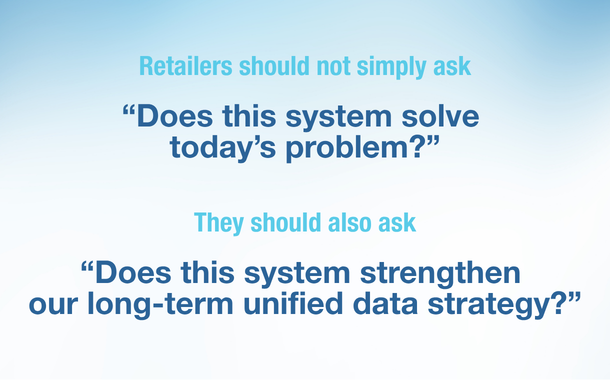
Technology investments should not be made in isolation to solve a singular challenge. Investment decisions should be evaluated and made based on a connected, long-term data strategy. Making this shift will help retailers drive tangible commercial outcomes that can directly support:
- Smarter fuel pricing
- Identification of underperforming sites
- Improved fuel-to-shop conversion
- Better loyalty targeting
- Reduced operational inefficiencies
- Reduced fuel losses
- Improved responsiveness
- Better customer experiences
Unified Data = Actionable Insight = Commercial Impact
What the fuel retail industry does not need is more data. It needs better ways to unify data that will enable retailers to turn their site data into actionable insights. Retailers who can effectively do this will outperform their competition.
Shifting towards unified data will drive actionable insight for fuel retailers. Actionable insight will result in tangible commercial impact. Connected data enables faster action, and faster action creates measurable outcomes.
The next stage of maturity is using operational information proactively, which means ppredicting issues before they escalate, identifying patterns automatically, prioritising interventions intelligently, enabling decision-makers to focus on what matters most.
In summary:
- Data Only Creates Value When It Drives Decisions
- Collecting Data Isn’t the Goal — Acting on It Is
- Unified Data Unlocks Insights That Isolated Systems Cannot
- And Small Insights Can Drive Major Results
Related Products

Copyright © 2026 Dover Fueling Solutions® | A Dover Company | Privacy Policy | Cookies | Terms of Use


Dover Fueling Solutions
Dover Fueling Solutions